How to homeschool multiple ages at once
You have a 9 year old who needs long division, a 6 year old who is just starting to read, a 4 year old who wants to do whatever the big kids are doing, and maybe a baby on your hip. Here is how families actually make that work.
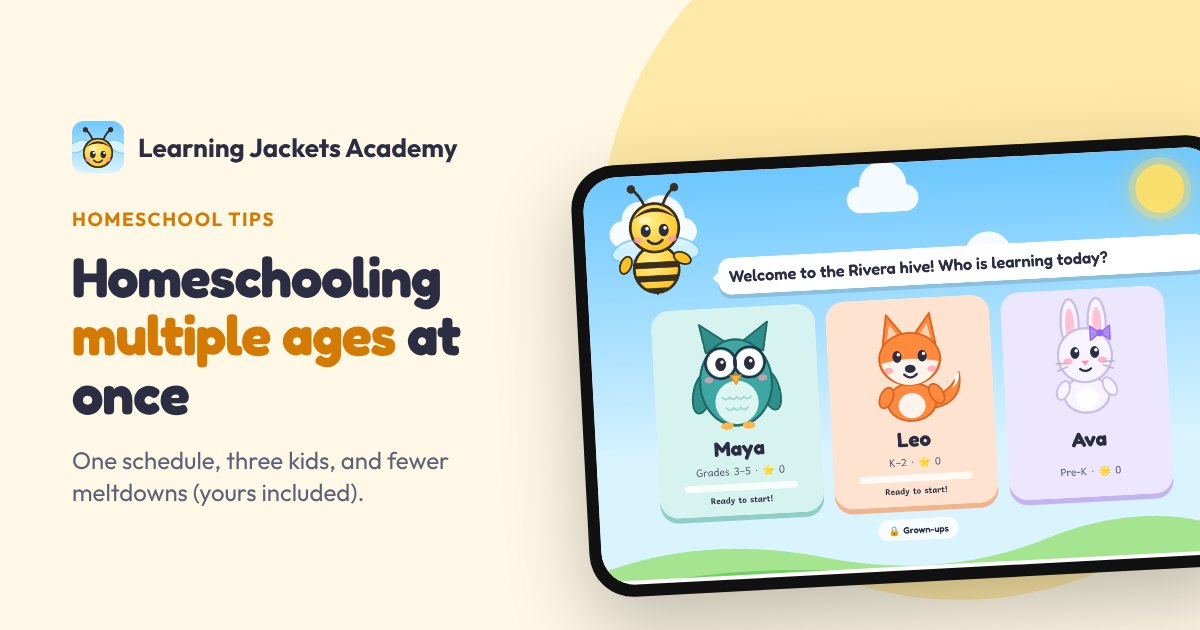
The first year of homeschooling several kids usually looks the same. You try to run three separate school days in parallel, you spend the morning running between the kitchen table and the couch, and by lunch everyone is crying, including you.
The fix is not more hours or a better curriculum. It is splitting the day into two kinds of learning: things the whole family does together, and things each child does at their own level. Once you see the day that way, most of the chaos goes away.
Teach together what you can
Some subjects do not need to be taught at grade level. Kids of very different ages can share them, and each one takes away what they are ready for. These are the ones most families combine:
- Read-alouds. A chapter book at the older child's level works for everyone. The 4 year old follows the story, the 9 year old picks up vocabulary.
- Science. One topic, like weather or plants, with one experiment. The little one predicts and watches, the middle child draws what happened, the oldest writes it up.
- History and geography. Same story for everyone, different depth. Narration from the younger kids, a short written summary from the oldest.
- Art, music, nature walks and PE. No grade levels needed.
Many families start the day with a "morning basket" or circle time: 20 to 40 minutes on the couch with a read-aloud, a poem, the calendar and a short science or history lesson. It gets everyone into school mode at the same time, and it covers a surprising amount of ground over a year.
Keep the 3 R's separate
Reading, writing and math are the subjects you should not combine. A child learning letter sounds and a child learning fractions need completely different lessons, and both need practice at exactly the right level. Too easy is boring. Too hard is tears.
This is where homeschooling multiple ages gets hard, because these subjects usually need a grown-up. The trick is to make sure only one child needs you at a time.
Rotate: one with you, the others on their own
Think of your time in short blocks. In each block, one child gets you one to one, and the others do something they can do alone. Then you swap. A 20 minute lesson with you, followed by 20 minutes of independent practice, is a good rhythm for elementary kids.
What counts as "on their own" depends on age:
- Toddlers and preschoolers: busy bags, play dough, puzzles, blocks, an audiobook, or a short, time-limited learning app that reads everything out loud so they do not need you.
- Ages 5 to 7: handwriting practice, a math worksheet they have already been taught, reading to a stuffed animal, drawing what you read in the morning.
- Ages 8 and up: written practice, a reading log, independent reading, a project. Older kids can also check their own work against an answer key.
Teach the oldest first if you can. The 9 year old is the most able to work on their own afterward, which frees you up for the beginning reader, who needs you most.
A sample day for three kids
Here is one realistic schedule for a 9, 6 and 4 year old. Your times will be different. The shape is what matters.
| Time | 9 year old | 6 year old | 4 year old |
|---|---|---|---|
| 8:30 | Morning basket together: read-aloud, calendar, a poem (30 min) | ||
| 9:00 | Math with you | Handwriting | Puzzles or busy bag |
| 9:20 | Math practice on their own | Reading lesson with you | Learning app (15 min) |
| 9:40 | Independent reading | Reads to the 4 year old | Listens |
| 10:00 | Snack and outside time | ||
| 10:30 | Writing on their own | Math with you | Play dough at the table |
| 10:50 | Writing check-in with you | Math practice | Free play |
| 11:05 | Finishes writing | Free reading | Letter sounds with you (10 min) |
| 11:15 | Science or history together, with a hands-on activity | ||
| 12:00 | Lunch. Formal school is done for the 4 and 6 year olds. | ||
That is about three hours, and it is plenty. Younger kids need far less formal school time than a classroom day suggests, because one on one teaching moves much faster than teaching 25 children. The afternoon can be free play, reading, chores, errands and the 9 year old's project.
What to do with the toddler or baby
Plan school around naps. The hardest one to one lessons, usually reading with your beginner, go in the nap slot. Keep a basket of toys that only come out during school time, so they stay interesting. Let the toddler sit in on morning basket even if they wander off. And accept that some days the baby wins, and school is a read-aloud and a walk. That still counts.
Give older kids some independence and some responsibility
By about age 8, most kids can follow a simple checklist for their own work: three things to finish, in any order, and a box to tick. It gives them ownership and gives you time back. Older siblings can also read to younger ones, quiz them on math facts or run a game. Kids often remember more from teaching something than from being taught it.
Common mistakes
- Running three full school days. Combine the content subjects.
- Teaching everyone at the oldest child's level. Separate reading, writing and math.
- Leaving the little ones with nothing to do. Plan their "on my own" activity as carefully as the lesson.
- Copying a classroom schedule. Two to three focused hours is enough for most elementary kids.
- Giving up after a bad week. Every family has them. Shorten the day, keep the read-aloud, and start again Monday.
The short version
- Teach read-alouds, science, history and art together.
- Keep reading, writing and math at each child's own level.
- Rotate in short blocks: one child with you, the others on their own.
- Teach the oldest first, and put your beginner reader in the nap slot.
- Two to three hours of focused school is a full day.
Learning Jackets Academy was built by a homeschooling family with three young kids for exactly this problem. Each child gets their own path at their own level, from Pre-K to 5th grade, and every instruction is read out loud, so a child who can't read yet can work on their own while you teach a sibling. When someone is stuck they tap 🙋 and it shows up on your phone. Pre-K has a daily screen-time limit you set. Try it free for 14 days.
Build your hive